
TTRPGs -> Cypher System -> The Magnus Archives
The Magnus Archives
[Folder Themed Interface]
Select one of a few different folder icons.
[___PCs___NPCs___Monsters__Sessions__]
[These will take the user to special windows on the same webpage with details. PCs will have summary page, character sheet PDF viewer, and info on what they've done in any campaigns they've been in. Monsters [&] NPC will be similar without a full PDF sheet. Sessions will have summaries of the sessions that can be viewed by clicking on a campaign and flippiing through a logbook interface.]
What Is The Magnus Archives?
Ahhhh...The Magnus Archives! One of my
The Magnus Archives is a podcast series by Rusty Quill and one of the best audio dramas I have ever listened too! It had a fantastic cast, ominous music, a killer intro theme, and excellent scares. The horror was Lovecraftian. The slow unraveling of pieces being put together, revealing an eldritch truth. One
If you immediately thought of Lovecraft, congratulations!
So, if I love the audio drama so much, why does the game fall a bit flat. To be honest, it really shouldn't! The Magnus Archives heavily embraces the audio format and utilizes the fact you can only hear what's happening to enhance the horror. Cannonically, you only hear what people have been recording on tapes. Sometime the spooky tape players turn on all by themselves, but it is this limited viewpoint and restriction to pure audio that helps The Magnus Archives stand out. Only one other podcast, The White Vault by , has entirely pulled this off. This also makes The Magnus Archives difficult to adapt to other medias. But a TTRPG is probably one of the best options. The issue comes down to two main things: the system and the changes made to that system.
Cypher System and Changes
So, full disclosure, I haven't played a ton of tabletop games. I've always found them facinating, but before running a campaign of The Magnus Archives with three of my friends, I had only played two other systems. One was a custom system a friend of mine made called Mad Island, which I will eventually post about, and the other was Chronicles of Darkness, which is different than World of Darkness. I had also never run a game as a Storyteller/Gamemaster before, so a lot of my frustrations can be chalked up to inexperience and learning the systems. That said, having experienced loads of RPGs through video games.
D&D was the system I had been exposed to the most. This was through games like Planescape: Torment, Baldur's Gate 3, and the Neverwinter Nights series.
I have a pretty good grasp of what makes games fun and engaging. And there are several issues I have run into, while using the Cypher System. The Magnus Archives also changes several things from the Cypher System's base rules, but we need to go over those first.
 The Cypher System is a fairly basic and modular ruleset designed originally for a game called Numera. It has since been used as an adaptable base system which can be easily molded into any theme or property the designer wants. It focuses on being rules light, easy to run, and narritively focused. Unlike DnD and other more specialized systems, which are often really good at particular things (Combat for DnD), the Cypher System is the Jack-of-All-Trades. And in many ways, it is pretty easy to get a hold of the basic rules.
There are even some things I really like! The d20 roll system is solid. Basically you have a chart listing difficulty levels from 1 to 9 and you multiply that number by 3 to get your target. Rolling a 20 gets you a auto-sucess and you get either xp or some extra effect decided by the Storyteller. You can spend either Might, Speed, or Mind points based on your tier, basically level, to reduce the difficulty. Abilities also reduce difficulty, so you can bring it down from impossible to likely in the late game. There is also the intrusion system. At least once or twice per session, the Storyteller is supposed to have an unexpected surpise interupt gameplay. Someone trips, a monster jumps out of the closet, a car runs a red light, and so on...The players get some xp and now have to quickly adapt to the sudden shift.
However, in an ironic twist, both of these things (which I do like!), also feed into some of my issues with the game. The first is that, at least in my sessions, it has become too easy for players to guarantee successes by using abilities and effort. This is on top of the ability to re-roll by spending a point of xp. And you get xp from both doing really poorly and really well, so it creates this feedback loop that quickly ramps up. While that could be exciting, it is ruined by the linear player progression.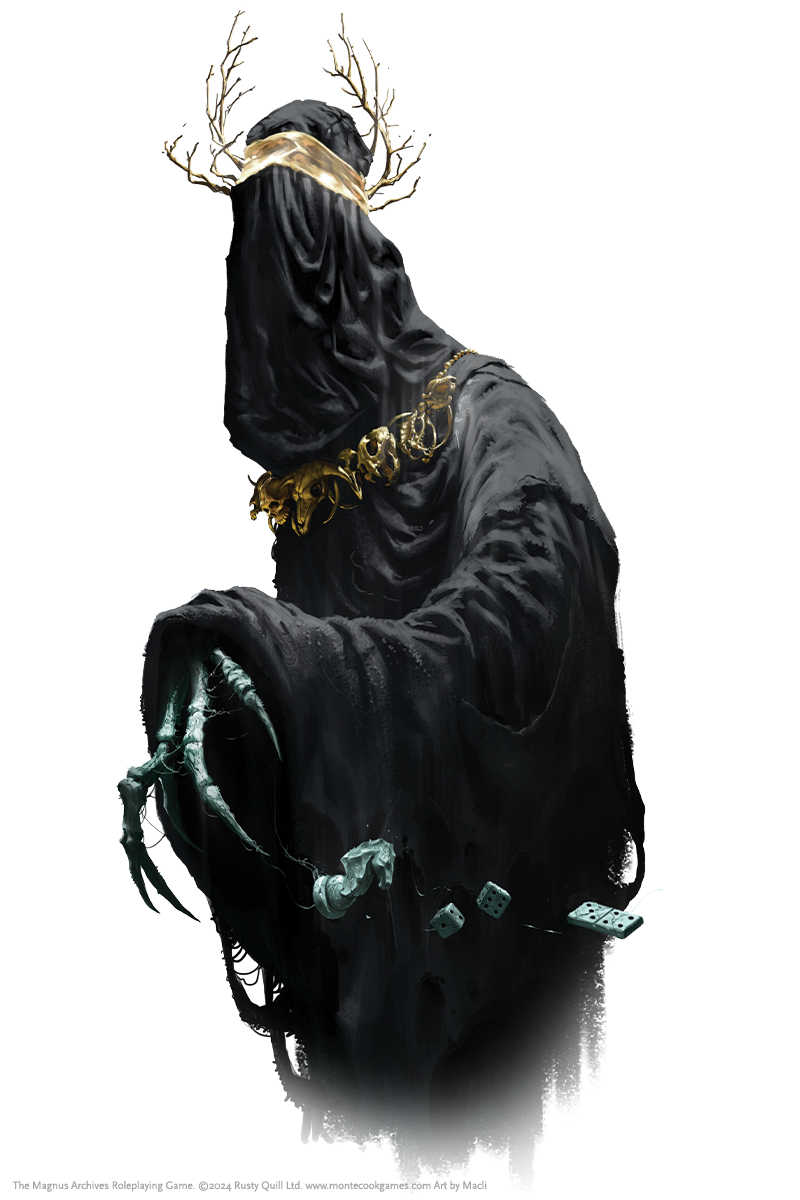
The way the cypher system works is through character tiers. Your class and descriptors unlock new abilities as you progress through tiers. In order to reach the next teir you must unlock 4 out of 5 'advancements'. These include, increasing a stat pool, gaining an edge in a stat, increasing the maximum number of effort you can use at once, gaining a new skill, or a vague 'other' option. You can only take one of each per tier and only 4 of them. Then you progress to the next tier and basically get a level-up.
This is actual an interesting system in many ways, and I like the way the level up is staggered across the various smaller benefits. I actually don't have a problem with the structure for advancement...I have a probelm with the cost. Every advancement cost 4xp. That's it. It takes 16xp to level up. 16xp gets you from tier 1 to tier 2. And 16xp turns tier 5 to tier 6. This is opposed to other games where leveling and stat increase cost exponenitally more experience, so the characters don't become to powerful/capable too quickly.
An example of an exponential system would be DnD, where you need more an more xp to reach the next level. Or World of Darkness, where increasing attributes requires you to pay a cost equal to a base value times the number of points you already have in that stat.
Still, despite these issues, the cypher system is pretty solid and easy to use at its core, which is what it was designed for. As a first time Gamemaster, I can say it was easy to get to grips with and wasn't too complicated to run. Unfortunately, The Magnus Archives altered some things and broke the balance.
Okay, without going on a overly long rant. *Nervously looks up at the wall of text I have been typing and realize it might be too late for that.* I hate a lot of the changes the Magnus Archives book made to the base cypher system. See, I have three players in the game. One supernatural guy min-maxing into Mind, a ex-soldier with good Might/Speed, and a weirdo mad-scientist (Corvast is great!) who has good Mind and pretty good Speed. Now, as these players went throught the game, the ex-soldier (named Victor) was starting to have trouble.
Due to the premise of the team working for a supernatural investigation organization, a lot of the stuff they ran into was deductive or social. And even when they got into combat, getting in close was dangerous or they needed to run away. This led to Might rolls being rather rare. And partly this is on me for not being more creative with blocked doors and giving him more chances to use might. But it's also partly the game! See, in the base game, Might acts as your health pool, with a stress system complimenting it. But in the Magnus Archives, the stress system is the entire health system!
And look, I get it, they wanted to do the Lovecraft-style sanity meter. But that was already in the game. Now everything does stress damage, and the Glass Cannon Occulist is somehow more resistant to monsters sometimes than the burly ex-soldier! (DAMN MATT AND ALL HIS WEIRDNESS! Lol! Not really, I have fun with the RP of his character, but he is a bit of a powerhouse.) It took a stat, which already has a hard time in investigation stories, and made it even less useful!
Then there are the Avatars...oh boy! Okay, short version, in TMA Avatars are people who become connected to the eldritch fear gods and gain powers at the cost of basically becoming monsters. These guys are insane in the books. They are extremely durable, capable of killing on massive scales and have powers that are just freaky. Wax skin, invisible fire, rearranging internal organs, forcing people to answer anything you ask, immortality, flight, creating diseases. They are harbingers of fear, terror, and madness...and in the game the powers they get are
Some of these abilities are worse than hitting someone with a baseball bat! And even the ones that are okay (Still not great, but acceptable) are all based around mind and supernatural stress. Like a Hunt Avatar should be more might and speed based, but the ability needs minds to function for some reason. The entire Avatar system sucks. The one character who might want to become one, has asked if we can homebrew abilities instead. That's how bad they are! And now I, as a new GM, have to worry about breaking the game so my player can enjoy one of the core parts of the setting!
*TEARS CLAWS ACROSS THE FLOOR IN FRUSTRATION!*
...
*Takes several deep breaths, until flames stop coming out my mouth.*
Conclusion
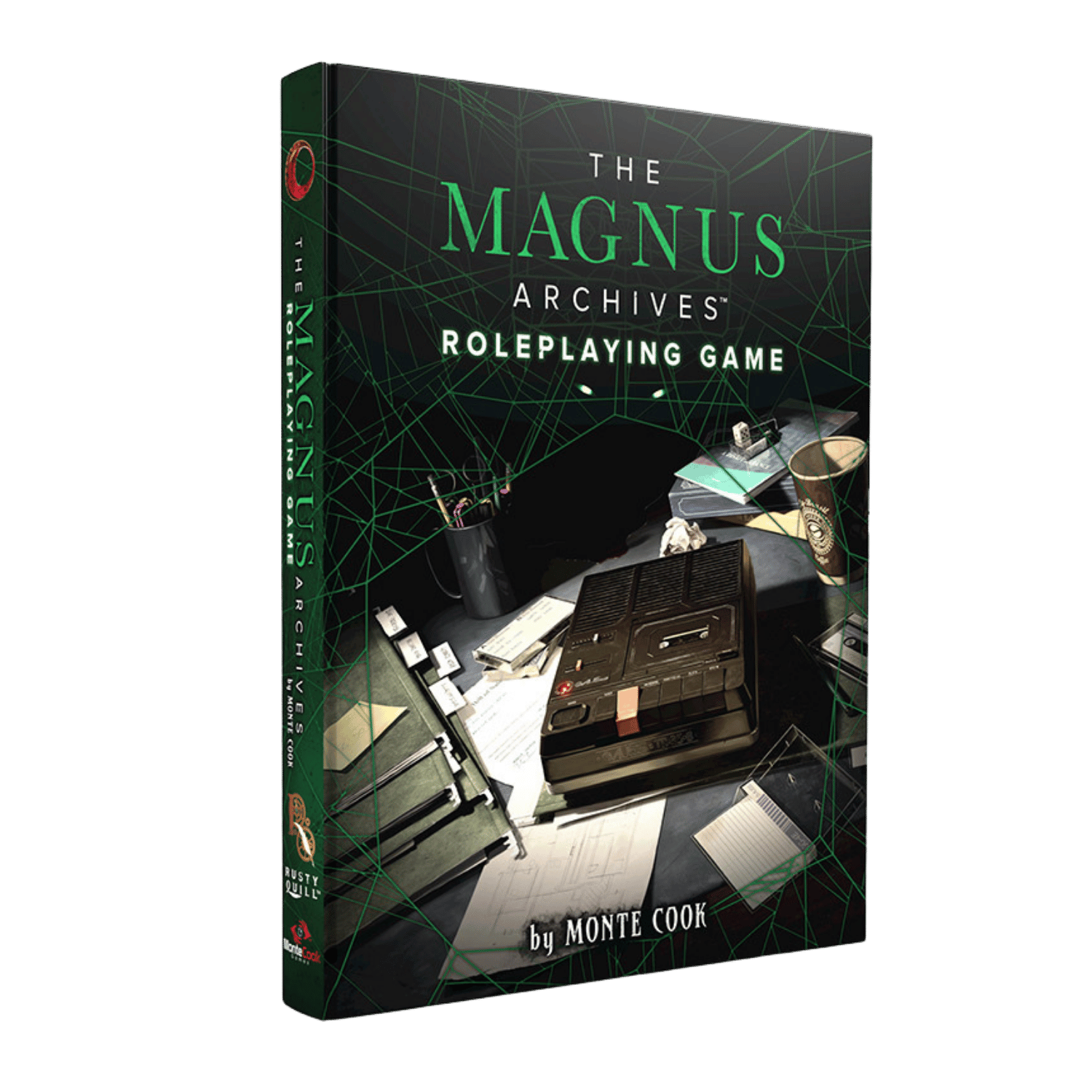
In conclusion, while I do like the setting and have had fun running these games, I feel like the Magnus Archives wasn't exactly the greatest game to start with. I think the Cypher System is pretty good as a beginner system, but it has issues and the Magnus Archives made it worse. This is on top of the fact that the Magnus archives book seems to be slightly unfinished. Some rules only vaguely explain themselves and there are some weird inconsistencies that me and Matt's player found while going through it. (The two of us rant about the rules on discord sometimes.) I like the setting. All the new monsters the book had, some of which had only been referenced and not encounter in the original were great!
I particularlly liked both the included stories and did pre-order the two expansion books, one of which has 10 new investigations to run. The art and theming was really nice, which makes some sense. I just wish the game was better balanced. Still I've had a good time playing this, and it was a decent introduction to the world TTRPGs. I have heard another spin-off of Rusty Quill's work, Old Gods of Apalachia, is pretty good, but I haven't tried it yet. I'll probably post an update once I get the new books for Magnus, but I doubt they will significantly alter my opinion.